In an earlier post I covered what exactly it is I’m doing here – focusing on knowledge-sharing and capacity building around change management and employee engagement. But I realized I didn’t really mention what it is MAS Intimates is trying to change, beyond “culture”.
A quick overview… MAS Intimates is a leading garment manufacturer (for brands such as Victoria’s Secret, Calvin Klein, Gap, etc.) who employs approximately 41,000 people. They have recently developed both a 2021 and 2025 strategic plan focused on evolving the company to be future-oriented and sustainable.
MAS is a major company in South Asia and in the manufacturing industry they are often looked to as leaders to imitate. An industry which has not always historically been known for the best human resources (or in some cases, human rights) or environmental practices. Because of this, and because of their position as a sector leader, MAS feels a responsibility to lead bold changes across the industry.
Following a fairly recent leadership change MAS Intimates is undertaking major business changes across the organization in order to achieve bold new strategic goals, also in-line with some of the bold, innovative work Sri Lanka is doing as a whole (around the UN’s Sustainable Development Goals).
The new MAS is focused on sustainability: for the environment (no small feat in a sector with a massive environmental footprint); for its employees (and particularly women – helping them build and diversify their skill sets to ensure they continue to have employment options in a rapidly changing sector); and for the business (one that is rapidly changing as global demand for “fast-fashion” and “mass produced” products is diminishing. Obviously changing demand for consumer fashion will impact MAS, but it will also Sri Lanka as a whole as textile manufacturing is the primary industry here, followed by tea production.
And yet, MAS themselves will be the first to tell you their industry need to change. The environmental footprint of producing and consuming mass-produced fast-fashion needs to be greatly reduced; their employees need to be provided opportunities to expand their skill-sets in a world moving more and more towards automation and better their circumstances so they they work these jobs out of choice, not out of lack of alternate options; and their business model needs to change to one that re-thinks how garments are made.
Here’s a link to an article that shows how MAS is doing just that – From Waste to Wearable: The Journey of the New Sri Lanka Cricket Jersey.
All these things sound great – so why is change management needed? Isn’t everyone on board? The initiatives sound great – and are great – but they don’t fit with the “old” MAS or the “old” culture and change is hard. For anyone. But especially a company of this size, spread out among so many office and plant locations, and with employees from all different backgrounds – generations, religions, and classes (which is very much a real factor in Sri Lanka).
Change gets even harder when focusing on environmental sustainability means changing the ways fabrics are sourced, dyed, treated, and shipped. All of which impacts jobs and prices, which in turn hits the bottom-line.
Also hard is sustainability for employees. Offering new skills-training is an amazing benefit, but offering this outside of work hours means many women (in Sri Lanka it is primarily still women who are responsible for all house, child and ill/elderly family member related work) can’t attend. This is further exaggerated by the class system here, as lower class women won’t have maids at home to help. But offering training during work hours means women need to feel their job is safe if they take time out of their days to attend, which in turn impacts their output productivity. Measures are put in place to ensure they will not be penalized, but convincing people of this takes time. And in a business historically focused on output – a huge culture change.
Affecting change of this kind is a little bit like trying to turn the Titanic. And with an industry so rapidly changing, there may well be an iceberg up ahead. For this reason, change management training and capacity-building will (hopefully!) help the team leading this initiative to make in-roads towards realizing their new strategic goals.
It’s a huge mandate, but I am extremely grateful to be able to contribute in some small way.
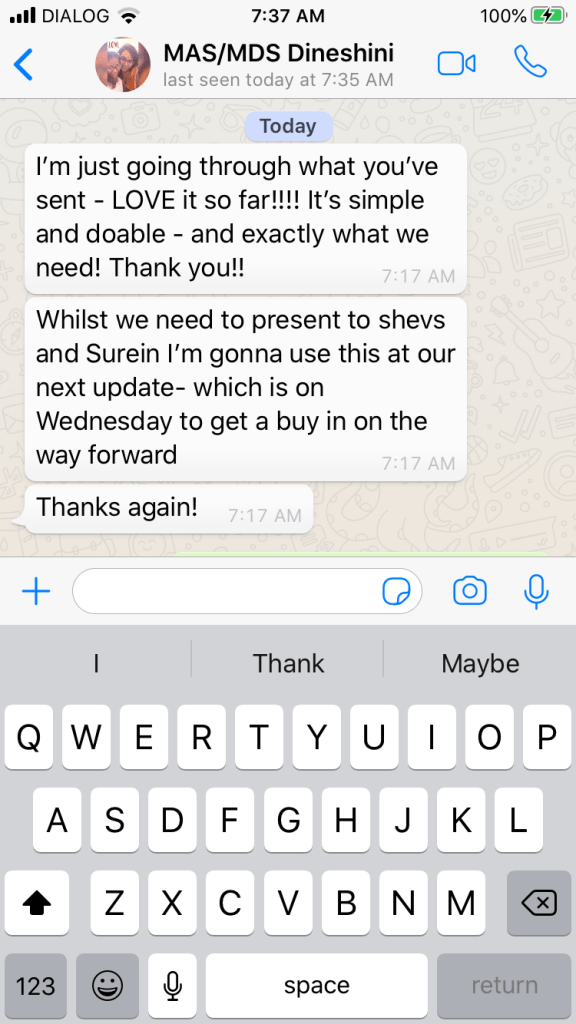
As I wrapped-up week 2 and prepared to lead a change management workshop at the start of week 3, I was thrilled to received this message from the team I am working with. Definitely a highlight of my very-special time here in Sri Lanka.
 Amy's Leave for Change Experience - Sri Lanka 2020
So so proud of you Amy.
What you do will have an impact and lasting impression on those you interact with.
Exciting work.
It continues to be a huge struggle for women throughout the world.
You are a woman beyond measure in my eyes.
LikeLike